The Dutch automated insulin delivery system developer added a a $13 million extension to that Series D round in January. CEO Tom Arnold outlined the company’s plans for the cash infusion last year, including scaling manufacturing.
Today, the company announced a significant manufacturing capacity expansion through a partnership with Phillips Medisize. It enables ViCentra to quickly bring its Kaleido insulin patch pump to more people in Europe and, eventually, the U.S.
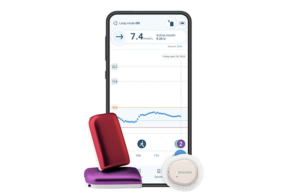
Kaleido is a miniature, patch-style insulin pump. ViCentra describes it as the smallest, lightest and most precise insulin patch pump in its class. The system comes with two durable, rechargeable pumps, eliminating the need to dispose of the pump every three days, while the infusion set lasts for a three-day span. Rather than a traditional syringe pump setup, Kaleido has a micro pumping chamber that uses valves alongside a unique blockage detection system.
ViCentra also recently launched its Kaleido smartphone-controlled hybrid closed-loop insulin delivery system in Europe, pairing Kaleido with Diabeloop’s DBLG2 algorithm and the Dexcom G7 CGM.
Arnold spoke to Drug Delivery Business News about the significance of the company’s latest announcement and what’s next for ViCentra.
The following has been lightly edited for space and clarity.
Drug Delivery Business News: A lot has happened at ViCentra in less than a year. Can you give an overview of how quickly the company’s milestones have piled up?
Tom Arnold: “We did raise $100 million and we immediately began deploying that money. I said [in August that] that the most important thing is to scale manufacturing. It’s holding us back. We were 100% supply-constrained. We embarked on a very ambitious timeline to be up and running with our contract manufacturer, Phillips Medisize, by June 1. We’re not only going to hit that date, but we’re going to beat that date by a few days.
“It’s a real testament to the team, and it’s a game-changer for Vicentra. Not only does it give us unconstrained supply for the first time in our company’s history, but it really expands our gross margin profile, allowing us to do the kinds of things and invest in the types of capabilities that take us to that next level —first in Europe — and gets us to the United States. We’re thrilled to be able to hit this milestone, because it really drives everything else that we want to do over the next 12-18 months.”
What are the details of this partnership that increases manufacturing capabilities?
Arnold: “It more than triples our supply almost immediately. We go from being able to support about 5,000 users today to more than 17,000 users. That’s a game-changer that allows us to go aggressively into Germany as we’ve planned, as well as begin to take more share in the Netherlands and in France. Into next year, it allows us to grow into other countries in Europe and prepare for significant market introduction in the U.S. near the end of next year.”

How does your new manufacturing partnership position you for expansion with eyes on the U.S.?
Arnold: “We picked Phillips Medisize from a strong list of really good contract global contract manufacturers. We felt Philips Medisize, being a wholly owned American company, in light of the geopolitical issues around the world, gave us the best opportunity to bring a low-cost product into Europe, as well as prepare us for for U.S. market entry. Philips Medisize really is one of the top five CDMOs in the world, particularly in medical devices. They’ve been a fantastic partner for us over the last 9-10 months, they’re they’re part of the reason we were able to get this launch done as fast as we did. They’ve just been exceptional partners for us.”
Phillips Medisize brings capabilities across medtech, but especially in drug delivery and diabetes. How does that factor into their production of Kaleido tech?
Arnold: “They’re producing our insulin cartridges and our infusion sets, so it’s important that they have that capability. We’re not just starting with a new supplier that has to kind of build up that learning capability. We picked one that we knew could do the job, and could do the job very well. Patient safety is the most important thing for our company and for me. My youngest daughter is a patient, so every day we wake up, making sure that the decisions that we make always put the patient in the first position. Phillips Medisize really gives us the confidence, not only that we’re going to produce a high-quality product, but that we’re going to be able to do it reliably, at scale and be able to make sure that we have the necessary supply to support all of our users whenever they need it.”
Another recent milestone was the launch of the smartphone-controlled Kaleido. What was the significance of that?
Arnold: “Last year, we said that there were three priorities for us now that we had the funding. The first was to scale manufacturing, the second was to scale commercially, and the third was to get to the United States with our next-generation product. We’ve achieved one. We’ve dramatically expanded our presence in Germany. For the first time, we’ll be able to cover the entire country. We’ve almost tripled the sales team there over the last three or four months.
As the other big names in insulin pumps move forward with their own miniature, patch-based systems, how do you position yourself against them as you make these strides?
Arnold: “I think that, when you put our product on a table and you compare and put it alongside every other product in the market — today and in the future — ours stands out. It stands out, not just because it’s colorful and it’s got an elegant look and feel, especially the next-generation product, but it’s also the smallest and it’s the lightest. When you have to wear a patch pump, that weight is really, really important. Our product weighs less than four nickels. There’s no other pump in the world that can come close to that claim, and that’s true today, and that’s true 18-24 months from now.
“We also feel really good about the outcomes. We have the most precise insulin pump in the world from a dosing perspective. At low dosages, that makes a big difference. We’re able to deliver very good time in range, extremely good time below range numbers, and we feel like being in that competitive zone from an outcomes perspective, along with our look, feel, and the flexibility of wear options that we bring to the table, that we have a very competitive solution.”
What does that market position look like?
Arnold: “When we look at Germany, which is our biggest market, we’ve conducted research there to understand where our users are coming from. What’s really fascinating is that almost 50% of our users, or more, are coming from multiple daily injections. What that means is that Kaleido is their first pump, which means we’re growing the market, and that’s a great sign. In addition, the ones that are coming from other pumps are coming to us from some of the largest players in the space, so both Insulet and Medtronic, as well as Tandem and Roche in the German market, we’re taking share from all of them, and so we’ve been able to do that in spite of being supply-constrained.
“Now with the handbrake off, we’re really excited to see what we’re going to be able to do, first in Germany, then in the Netherlands, in France, then in other countries in Europe, and then eventually — and not too long from now — the United States.”