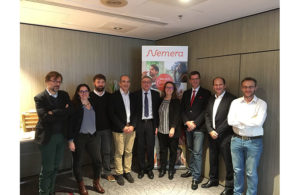
(Press Release) – “Connectivity in every new inhalation device?” This topic was one of those discussed with different inhalation experts – Manfred Keller, Pascal Cavaillon and Henry Chrystyn – during a roundtable organized by Nemera in Paris to review the advantages and limitations of inhalation devices.
Inhalation treatments, composed of solid particles or liquid droplets are generally administered to the lungs via inhalation limiting side effects versus other administration modes (oral, injectable etc…). Their efficacy depends on the drug used, the particle/droplet physical and chemical properties, as well as the patient’s breathing pattern, lung anatomy and physiology.
The inhaler device generating the particles/droplet is the direct interface with the patient and it can influence patient adherence and treatment efficacy. Four categories of inhalers exist.
Dry powder inhalers (DPIs) are portable and deliver small or large doses. They are passive devices requiring the patient to inhale with a high inspiratory flow rate.
Pressurized Metered dose inhalers (pMDIs) are portable and deliver small doses of solution or suspension. Their efficacy is limited by a strong need for coordination and an important deposition of aerosol in the mouth.
Soft mist inhalers (SMI) are portable and deliver a small dose of solution. In comparison with pMDI, they reduce mouth deposition and generate a “mist of droplets” lasting longer than the pMDI aerosol.
Nebulizers are medical devices delivering a high dose of solution. In this category, mesh nebulizers are becoming smaller and more portable.
The doctor’s choice of an inhaler for a patient is mainly done according to a patient’s preference after having tested different devices. This device selection is key in a treatment as some studies prove that the more a patient likes his inhaler the more adherent he will be. This roundtable raised the conclusion that the addition of electronic and connectivity on inhalers may also improve the adherence of patients and consequently, treatment efficacy in the future.
Read the full press release here.