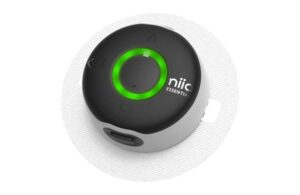
The all-in-one pump pairs the Niaa Essential insulin patch pump with the SynerG continuous glucose monitor (CGM) sensor developed by Pacific Diabetes Technologies. It features the sensor within the Niia device’s insulin infusion cannula.
Existing patch pump systems on the market that are similar — like the leading Insulet Omnipod platform. — offer automated insulin delivery by pairing a pump with a CGM. However, this system would be one device that features both the pump and CGM technology.
PharmaSens and SiBionics also have a collaboration aimed at developing the all-in-one solution. They are jointly developing the next-generation Niia insulin patch pump with a SiBionics CGM. PharmaSens expects a second feasibility study in the second quarter to evaluate the next-generation pump with SiBionics’ CGM.
(PharmaSens CEO Marcel Both and SiBionics Chief Strategy Officer Patrick Nowlin provided insights into the pump in an interview with Drug Delivery Business News at ADA 2025. Read more here.)
PharmaSens says the clinical feasibility study of Niia demonstrated for the first time ever that the combined offering is, in fact, feasible. It believes its device addresses the need for alternatives to multi-device diabetes management. systems.
“People with diabetes want technology that works quietly in the background and fits into everyday life,” said Both. “This feasibility study shows that combining continuous glucose monitoring and insulin delivery into a single, discreet patch device is not only desirable, but achievable. With our integrated technology approach and deep experience in diabetes care and medical device engineering, PharmaSens is uniquely positioned to be the first company to bring such a device to people with diabetes.”
More on the data shared by PharmaSens
The data, published in JDST, come from a single-arm feasibility study of the Niia Essential pump equipped with SynerG. It evaluated 18 adults, all living with type 1 diabetes for at least six months.
In the main phase of the study, 15 participants wore the device for 72 hours. They underwent two mixed meal tests (MMTs) and one supervised free-living day at a hotel. All participants used a Dexcom G6 CGM and separate blood glucose monitor (BGM) to guide glycemic treatment decisions. They also received manual bolus insulin dosing to ensure safety.
The main phase of the study took place after a pilot phase in which three individuals wore the investigational device for 10-12 hours while undergoing an MMT.
PharmaSens says its trial had a primary endpoint of accuracy, assessed by mean absolute relative difference (MARD). Secondary endpoints included pump performance, the number of insulin delivery failures and device survival duration.
Aggregated MARD for the investigational device came in at 11.6%. A MARD target of less than 10% is considered ideal for CGM devices, but PharmaSens said that, in the context of the early feasibility study, the results were encouraging and provide evidence supporting the development of an all-in-one system.
Error grid analysis highlighted clinical accuracy in 83% of readings, supporting the device’s accuracy. The study included no insulin delivery failures or adverse events.
“The PharmaSens niia insulin pump offers an excellent platform by which insulin delivery and CGM may be combined, and this study has demonstrated the feasibility of such an approach,” said Professor David O’Neal, study principal investigator and director of the Diabetes Technology Research Group at St. Vincent’s Hospital Melbourne, where the study was conducted. “A safe, reliable, ‘all-in-one’ device could substantially reduce the physical and psychological burden of managing diabetes, while also lowering the cost and environmental impact associated with using separate glucose monitoring and insulin delivery devices.”