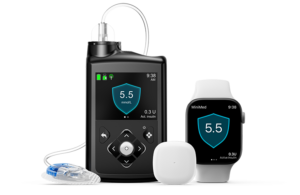
Findings demonstrated virtually identical glycemic outcomes for users of the pump across two different continuous glucose monitors (CGMs). Investigators published data today in Diabetes Technology & Therapeutics. MiniMed says outcomes reinforce that its automated insulin delivery (AID) algorithm, not the sensor, is the “primary determinant of clinical outcomes.”
The study randomized 24 adult participants with type 1 diabetes. They either used MiniMed’s Simplera Sync CGM or the Instinct sensor made by Abbott for a six-week period. Then, each patient crossed over to the alternative sensor for an additional six weeks. Each crossover period utilized a 780G pump to eliminate algorithm memory carryover effects.
Both sensors maintained strong time in range (TIR) during the study period. They exceeded international consensus targets for glycemic control as defined by the American Diabetes Association. Investigators saw no cases of diabetic ketoacidosis (DKA), severe hypoglycemia or unanticipated device effects.
MiniMed said the results build on preliminary real-world evidence from 4,364 U.S. MiniMed 780G users with type 1 diabetes. These outcomes showed that individuals transitioning from the company’s Guardian 4 sensor to Instinct maintained consistently strong glycemic outcomes. The company shared these findings at ATTD 2026 in March.
Additionally, the company said an updated real-world analysis of more than 20,000 U.S. 780G users living with diabetes showed consistent results, validating the algorithm’s central role in driving results.
MiniMed 780G’s adaptive SmartGuard algorithm automatically anticipates, adjusts and corrects glucose every five minutes. Meal Detection technology automatically detects rising glucose and adjusts insulin to help keep levels in range.
Commentary from MiniMed officials and investigators
Que Dallara, MiniMed CEO, said:
“This data provides compelling clinical validation of what we’ve always believed — that the power of our system lies in the intelligence of our SmartGuard algorithm. This growing body of evidence gives people living with diabetes the confidence to choose a sensor from our portfolio that best fits their lifestyle. We’re relentlessly focused on advancing the science behind automated insulin delivery and building a full-stack insulin delivery ecosystem that makes diabetes management simpler, more personalized, and increasingly hands-free.”
Amir Tirosh, principal investigator for the study, added:
“These results underscore an important principle in automated insulin delivery, which is that the intelligence of the algorithm is what ultimately drives glycemic outcomes. Across every key metric, the results between the two sensors were remarkably consistent, underscoring the strength and adaptability of the MiniMed 780G system.”