The likes of Abbott and Dexcom are leaders in the continuous glucose monitor (CGM) space. MiniMed, Insulet and Tandem Diabetes Care are a few of the companies with a significant share in the automated insulin delivery (AID) space.
Those companies are also publicly traded and bring in billions of dollars a year. What about the companies whose financials are a lesser-known quantity, but their technology is making waves?
We already compiled a list of the 10 largest diabetes tech companies in the world here. But, beyond the largest diabetes tech companies, who else is staking their claim?
(There’s plenty more to enjoy in our free-to-download special report covering all things diabetes technology. Go here to download the report.)
Sequel Med Tech

The Manchester, New Hampshire–based company built its twiist system to represent the next generation of insulin delivery. It measures the volume of insulin delivered and adjusts basal doses to the user’s needs, while delivering blockage alerts and more innovative features.
Following the system’s full launch in March for the type 1 diabetes population, the company also continues to seek out indications in type 2 as well.
Read our recent interview on what’s next with Sequel Chief Medical Officer Dr. Joanna Mitri.
ViCentra
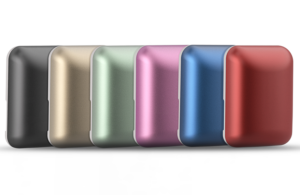
In addition to adding another $13 million to that funding round, the Dutch medtech company went on to announce a significant manufacturing capacity expansion through a partnership with Phillips Medisize. It enables ViCentra to quickly bring its Kaleido insulin patch pump to more people in Europe and, eventually, the U.S.
Kaleido is a miniature, patch-style insulin pump, and is available and expanding across Europe, while ViCentra has its eyes set on bringing it to the U.S. soon.
Read our recent interview on what the future holds with ViCentra CEO Tom Arnold.
Modular Medical

Pivot, the company’s tubeless patch pump, consists of two parts, with a 3 ml reservoir and a disposable battery. It features smartphone connectivity for bolus and monitoring, plus electronic accuracy without tubes or constant wear. Pivot won FDA clearance in April and launched in June.
The company believes Pivot offers simplicity, affordability and flexibility. It hopes to improve adoption and long-term outcomes while reducing costs.
Read more about Modular Medical and its Pivot pump.
Glucotrack

Rutherford, New Jersey–based Glucotrack develops a long-term implantable continuous blood glucose monitor CBGM that could provide a new alternative to the various CGM offerings out there.
The device features no on-body external component. The company aims to offer it for three years of continuous, accurate blood glucose monitoring for a more convenient, less intrusive solution. Unlike traditional CGMs that measure glucose in interstitial fluid, the CBGM measures glucose levels directly from the blood. It aims to provide real-time readings without the lag time typically associated with interstitial glucose measurements.
Glucotrack submitted its system to the FDA for investigational device exemption (IDE) earlier this year. The company recently completed a merger deal to become a subsidiary of Lōkahi Therapeutics.
Read our recent interview with Glucotrack CEO Paul V. Goode.
PharmaSens
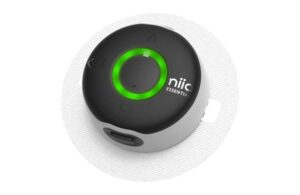
The all-in-one pump pairs the Niaa insulin patch pump with a continuous glucose monitor (CGM) made by SiBionics. The companies announced a collaboration aimed at developing the all-in-one solution last year. Their all-in-one wearable device would integrate insulin delivery and glucose sensing into a single, compact automated patch pump system.
The launch of this study comes on the heels of positive data from the first clinical study evaluating the pump with the SynerG CGM. PharmaSens said its clinical feasibility study of Niia demonstrated for the first time ever that the combined offering is, in fact, feasible. It believes its device addresses the need for alternatives to multi-device diabetes management systems.
Read more about PharmaSens’ all-in-one pump.
Portal Diabetes
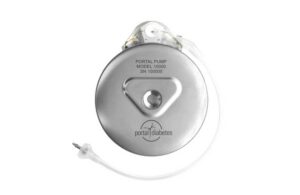
The Westfield, Indiana–based company can now begin a Phase 1 study to evaluate its proprietary, temperature-stable insulin. It aims to deliver a functional cure for type 1 diabetes.
Its Portal Pump is designed to leverage the physiologic delivery of insulin to the abdomen through an implantable device. The company designed it to work with modern continuous glucose monitoring (CGM) technology and stable, concentrated insulin. Altogether, this system hopes to fully close the loop on insulin delivery for type 1 diabetes.
An implantable system from Portal Diabetes would mark a first on the U.S. market.
Read more about Portal’s emergence with its implantable insulin pump.